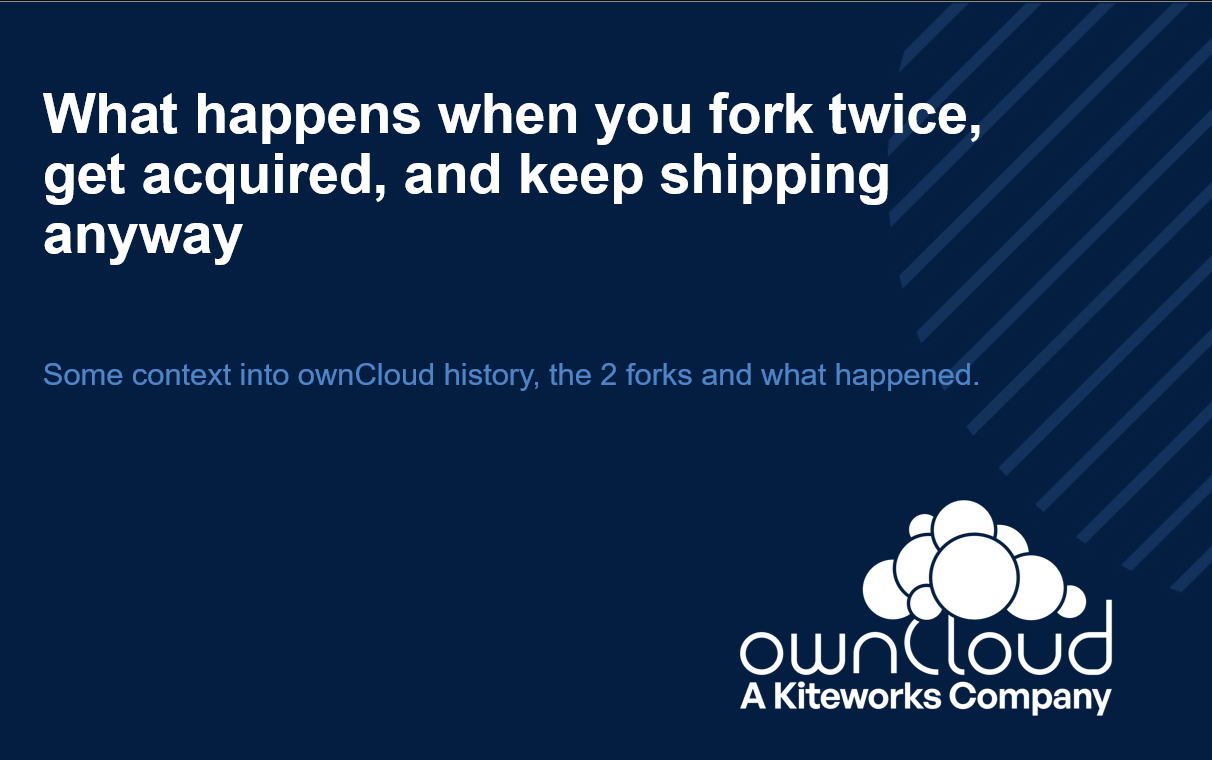
ownCloud has been forked twice.
The first time, in 2016, a significant part of the community and engineering team left to build Nextcloud based on ownCloud 10 aka ownCloud Classic aka ownCloud Server.
The reasons were real: governance concerns, transparency gaps, disagreements about the relationship between company and community.
People left. The project continued.
The second fork, based on ownCloud Infinite Scale, in 2025, was after the Kiteworks acquisition in late 2023.
Different context, different reasons, but the same underlying lesson: communication isn’t just about what you say. It’s about what the other person hears. Even well-intentioned decisions fracture communities if words, tone, or timing are off.
After the acquisition ownCloud kept shipping, dedicated teams were working on all ownCloud products: ownCloud Infinite Scale, ownCloud 10, Desktop Client, iOS and Android Client.
oCIS went from version 4.0 through five production releases to 8.0 today and 8.1 is very close by.
A huge installation is supporting millions of students and teachers, ownCloud kept operating it. Even more installations were added, such as the European Open Science Cloud and other Universities.
The Desktop Client went from version 4.x to the completely refreshed 6.0 line, and 7.1 is on the door mat.
There was a fear that the code would get closed off and that the community would get hollowed out after the Kiteworks acquisition.
While we kept shipping publicly to our open source repos, we were so focused on building, we did not find and commit the necessary resources into the community.
We have understood, that that projects diverge when voices feel unheard and governance becomes unbalanced.
The Open Source Manifesto commits to doing things differently, with specific mechanisms rather than vague intentions.
Tomorrow: we killed our own CLA.
Note:
This is part 2 of this blog post series. See the first post, A (re)-introduction to the ownCloud community.