Why community engagement is so important
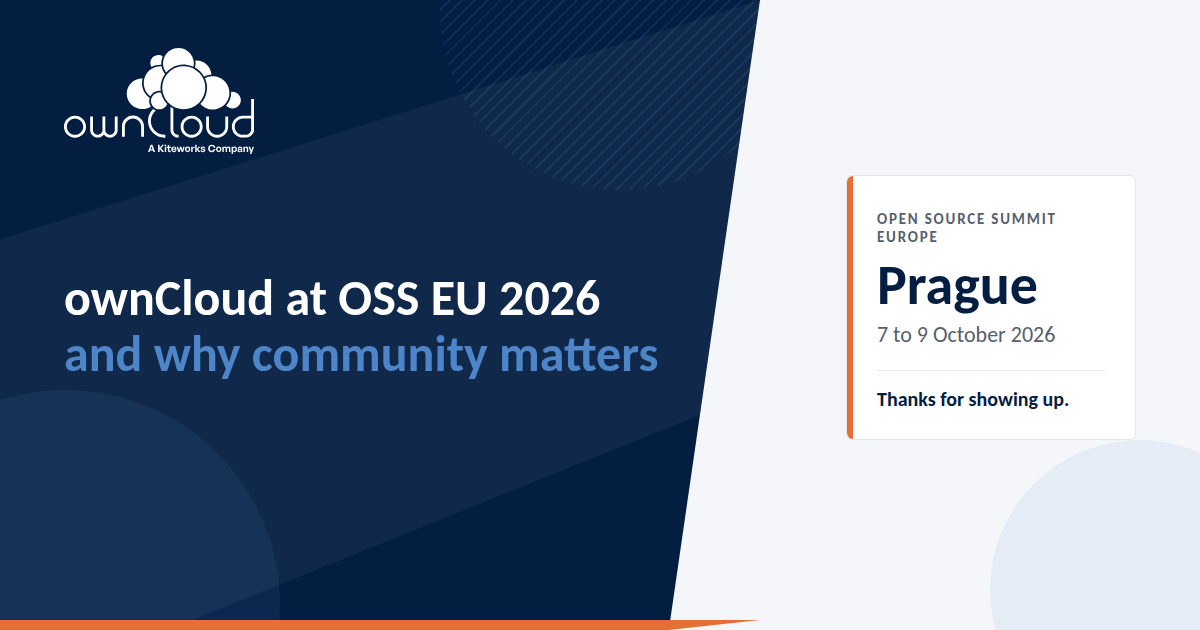
We had the privilege of joining the Linux Foundation’s Open Source Summit Europe in Prague earlier this month (7 to 9 October) as a sponsor. First, a big thank you to everyone involved for a wonderful experience!
We also weren’t alone. The booth was staffed by a mix of folks from ownCloud and Kiteworks, plus people from our partners Collabora, B1 Systems and Cesnet. Having everyone in one place meant almost any question, from “how do I run this at home” to “how would this fit our infrastructure”, could be answered by someone who actually works with it every day.
Our main goals were to re-engage with the community, (re-)introduce people to oCIS and ownCloud, and to listen. And oh boy, were we not disappointed. “I thought you were dead!” and “I’m so glad you’re still here!” were some of the things we most often heard from folks at the conferences and meetups we’ve attended this year, which makes sense, because unfortunately we dropped the ball in community engagement since the end of 2024, and we’ve apologized to the community and our partners for it. We let people down and working in a seemingly black box is the opposite of what Open Source stands for.
So, for the record: yes, we’re still alive. But “not dead” is a pretty low bar, and being back in the same room as you reminded me why I fell for open source in the first place. But it only works well when people show up, talk to each other, and occasionally tell you you’re doing it wrong. (We got a bit of all three – and we sincerely thank you for that!)
Here’s how the week went, starting a day before the summit with a room full of fellow OSPO nerds – and I say that with love.
Starting with OSPOlogy
Our week actually started the day before the summit, at OpenChain x OSPOlogy Prague. It was a full-day community event for people who work on open source management, supply chain trust and OSPOs, and it was a great fit for us. We launched the Kiteworks/ownCloud Open Source Program Office (OSPO) earlier this year, so it felt like being among our own people.
David Walter, who leads our OSPO, gave a session there called “Two Forks and a CLA-to-DCO Rewrite: What Actually Rebuilds Community Trust”. Honest conversations about forks, governance and trust are rarely comfortable, but they’re the ones that matter most for a project with our history.
We enjoyed the rest of the day just as much. Nithya Ruff’s keynote on OSPOs and open technology was a highlight, and so were the hands-on sessions. Dawn Foster’s roundtable on improving your OSPO with CHAOSS made the case for “strategy before metrics”, and one theme stuck with me: metrics need a narrator, because the same dashboard can lead two people to completely different conclusions. Ana Jiménez’s demo on using AI agents with CHAOSS security metrics gave us an interesting look into how she built AI tooling geared towards OSPOs.
If you missed it, the presentations and roundtable notes are collected in the OSPOlogy GitHub discussion (because of course they’re open – the day was centered around OSPOs and our love of Open Source!)
What we learned
A lot of people think we’re a cloud hosting company.
Given the name, that’s understandable, and we heard it often enough that eventually we stopped being surprised. Many people assumed we’d try to sell them a public cloud service and we need to fix that. One idea I’m toying with is a tagline like “Bring your own storage, create your ownCloud”.
Nothing is final, so tell me what you think.
Most people know ownCloud Classic, the PHP version.
Plenty of folks were still running it in their homelabs and were happy to find out the project is alive. Somewhere out there is a quietly humming box in a closet that has been faithfully syncing files this whole time, and I love that. But most of them had no idea oCIS exists – another thing to work on.
oCIS is fully open source written in Go, with no gated features.
This is the one that surprised people most. ownCloud Classic followed an open-core model, so many people assumed oCIS would too. It doesn’t and everything is open and not gated. This is definitely something we need to put front and center, because this was the selling point for a lot of folks. (The fact that it is cloud-native and doesn’t need a database to run, also left quite a few people eager to try it)
People were willing to try it.
Many of those who hadn’t heard of oCIS were keen to spin it up and try it out. That was probably the most encouraging part of the week. (You can use the same ownCloud demo site we used to try out ownCloud and Collabora right now)
People want to know what’s coming.
Questions about the future of ownCloud Classic, where oCIS is headed, and where to find the public roadmap came up a lot. That’s fair, and it’s an area where we can and want to be more transparent.
Lean or robust, your call
One question came up a lot: how big is this thing, really?
oCIS is as lean as you want it to be, or as robust as you need. Its modular, extension-based architecture keeps the core simple, so a small setup stays small and an enterprise can build up from there without the core getting complicated. Think of it as a very well-organized toolbox rather than a Swiss Army knife that never closes properly.
That’s deliberate. ownCloud focuses on file sync and share, and we’d rather pair that with best-in-class integrations (document editing with Collabora is a good example) than try to build everything ourselves. Doing one thing well, and playing nicely with others who do the same, is pretty much the open source spirit.
If you want to see how the extension side works, we wrote about the new ownCloud Marketplace, where Git is the app store.
“So what’s your business model?”
Once people hear that nothing is gated, the next question is almost always the same, and I love it. If the software is fully open, how does this work?
The project itself is not productized. Rather we have funding through organizations that need enterprise-level support that we maintain and build the features they need, which then land in the open codebase for everybody. These are ongoing contracts from the ownCloud Classic era who have now migrated to oCIS.
Kiteworks also backs the project as a corporate sponsor (they are our parent company now after all).
For people with needs we can’t serve directly, we point to our partner ecosystem, which is one more reason we were so glad to have partners like Collabora, B1 Systems and Cesnet at the booth.
There’s a bigger reason I care about this, too: digital sovereignty. With an open license, organizations know the code can outlive any single vendor, whatever happens to that vendor. For a lot of people we know that matters a lot.
If you want the longer story of how we got here (the forks, the acquisition, and what we’re changing), I covered it in my FrOSCon talk, Bringing back the Open in Open Source: (Re-)Building Community after forks and acquisition. It’s a case study, and not always a flattering one (and that’s maybe the point).
ownCloud Contribution spotlight
Contributing doesn’t mean only writing code. Documentation, tutorials, extensions, forum help, bug reports and feature requests all count, and you can bundle several smaller contributions into one entry (a lone typo fix is lovely, but it won’t make the spotlight on its own. Typo fixers, we still love you).
The ownCloud Contribution Spotlight is our way of saying thank you to the people who make ownCloud better.
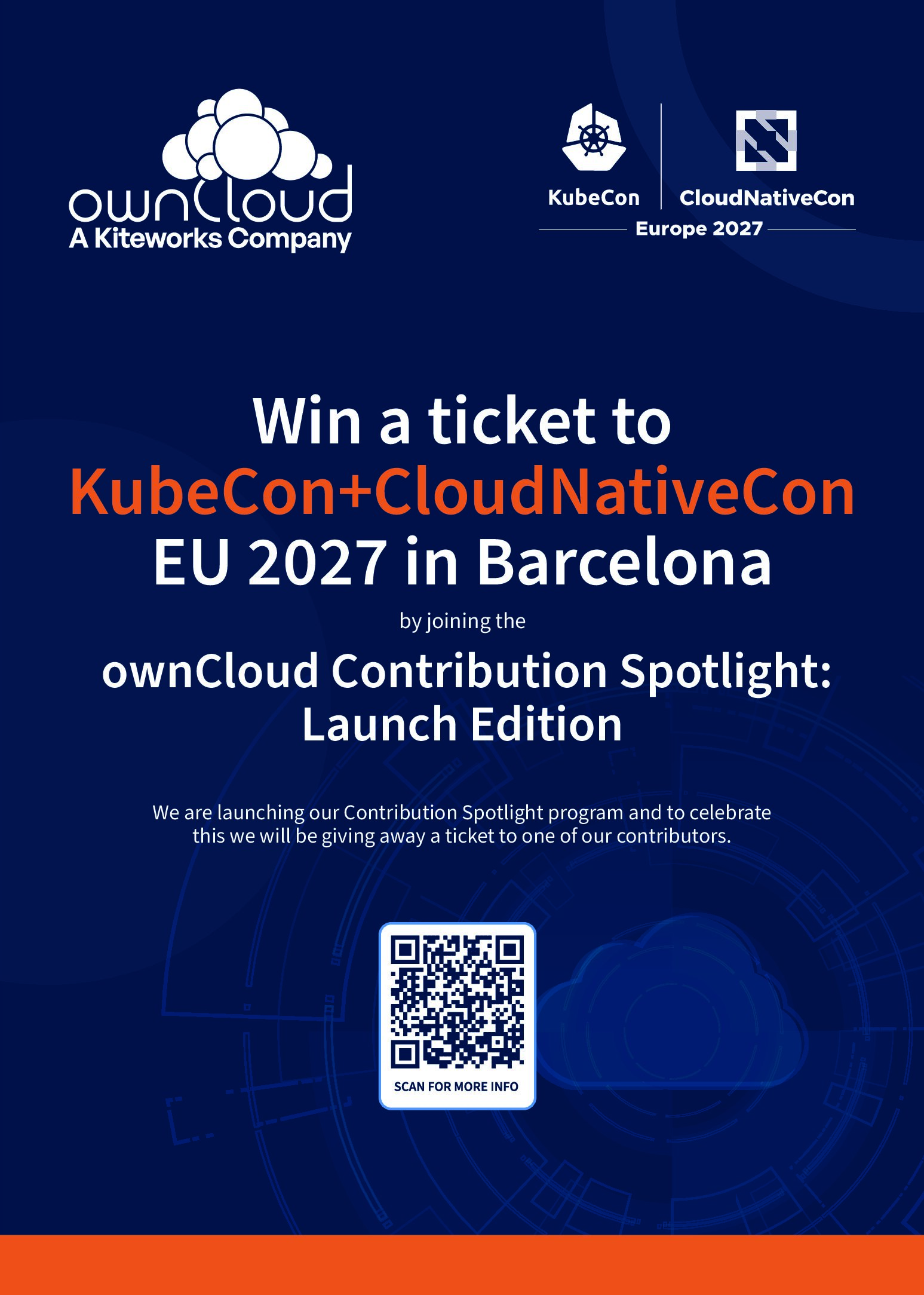
Entries for The Launch edition are open until December 1 and we’ll announce the winner at the Monthly Public Community Sprint review on December 18 who gets a ticket to KubeCon + CloudNativeCon Europe 2027 in Barcelona. Afterwards, from January 2027, this will be a program where we feature and reward a new contribution/contributor every month.
If you’ve contributed, or you know someone who has, join in.
Highlights from the team
For all of us, the best part was getting to interact with the community: hearing how people use ownCloud, what they want more of, and what they honestly think of the company and the product. The keynote conversation between Linus Torvalds and Dirk Hohndel on the last morning was also great, as was the OSPOlogy day.
A few other things the team took away:
- The event felt community driven, not sales driven. Nobody was trying to push a subscription, and if someone wanted help with their own setup, they could get it right at the booth.
- Some of us were surprised by how many people already know ownCloud. It’s good to see how well the project is regarded in the open source world.
- Talking with customers and partners left the team convinced that investing in open source is the right call.
- Explaining things to others is a very efficient way to learn them. Some of us arrived knowing less about ownCloud than we do now.
- Most visitors seemed genuinely interested in talking to the people behind the products.
- Long days on your feet at a booth are exhausting, though we get better prepared each time. (Comfortable shoes: the real open source infrastructure.)
And one more thank you, because it deserves its own line:
Thank you to the Linux Foundation, the events team and all the volunteers for a great event and a wonderful sponsor experience. Everything ran smoothly, and the people we met were great.
Come join us
If we met in Prague, thank you. You reminded us why we do this. If we didn’t, there’s still a seat for you, and here’s how to grab it:
- Subscribe to our community newsletter: com/community-events/#newsletter
- Join the community at owncloud.com
- Try out a demo of ownCloud and Collabora: owncloud.com
- Join our monthly public community reviews, where we share what’s happening and listen to what you want next: com/community-events
- Join the contribution spotlight and let us thank you properly: read how it works
- Learn more about how the Kiteworks/ownCloud OSPO approaches open source: kiteworks.com/open-source
Open source is only as strong as the people who show up for it. Come show up and engage with us.