
Blogs
Insights on secure data exchange, digital sovereignty, and open source — from the team that built the platform.
What Black Hat 2026 Proved About PHP-Based File Platforms
A Black Hat 2026 talk defeated PHP’s own memory hardening. Nextcloud and WordPress were named directly.
oCIS doesn’t run PHP. It’s Go, single-binary, no external SQL in the metadata path. That doesn’t mean immune, it means this specific bypass has nothing to reach.
Kiteworks Open Source Program Office (ownCloud)
Kiteworks empowers organizations to manage risk in every send, share, receive, and save of sensitive content, protecting over 200 million end users across thosuands of global enterprises and government agencies. The Kiteworks Open Source Program Office is the steward of ownCloud, the open-source platform for sovereign secure data exchange, file synchronization, and collaboration. Built from the ground up in Go with zero database dependency, ownCloud Infinite Scale scales from a single binary to million-user deployments. Guided by a published governance charter and Apache 2.0 licensing, the OSPO ensures ownCloud remains a transparent, community-driven digital commons.

Introducing the ownCloud Contribution Spotlight: a way of thanking the ownCloud Community
ownCloud has launched its Contribution Spotlight Program to thank our contributors (new and old!) and to celebrate the launch we are giving away a ticket to Kubecon+CloudNativeCon EU 2027
What’s New in ownCloud Web: A Summer of AI Extensions (and Two Admin Tools Worth Knowing About)
Eleven new oCIS Web extensions shipped this summer — AI summarizers, taggers, and a sensitive-data scanner, plus two long-requested admin tools. All AI features run through an operator-controlled proxy, so your LLM endpoint, your rules.
ownCloud Mobile Roundup: Android Closes an App-Lock Bypass, iOS Fixes File Provider and Drive ID Issues
Two ownCloud mobile patches out this week: 🔒 Android 4.8.4 closes an app-lock bypass (back gesture could skip the passcode/biometric prompt) 📱 iOS 12.7.1 fixes File Provider copy bugs + Drive ID compatibility for non-standard oCIS spaces

Three ownCloud Classic Apps, Three CVE Patches: What Landed on August 21
If you run ownCloud Classic with the OpenID Connect, S3 Primary Storage, or Dropbox external storage apps enabled, three small patch releases landed on the same day (August 21, 2026), and all three are dependency-only security fixes. None of them touch your...
ownCloud Infinite Scale 8.0.8: Share Metadata Corruption Fix and Two Security Updates
oCIS 8.0.8: fixes a share-metadata corruption bug under concurrent writes, patches a WebP decoding DoS issue + a Go stdlib CVE, caches LDAP lookups, adds optional NATS TLS. Patch release, no config changes needed.
What Black Hat 2026 Proved About PHP-Based File Platforms
A Black Hat 2026 talk defeated PHP’s own memory hardening. Nextcloud and WordPress were named directly.
oCIS doesn’t run PHP. It’s Go, single-binary, no external SQL in the metadata path. That doesn’t mean immune, it means this specific bypass has nothing to reach.
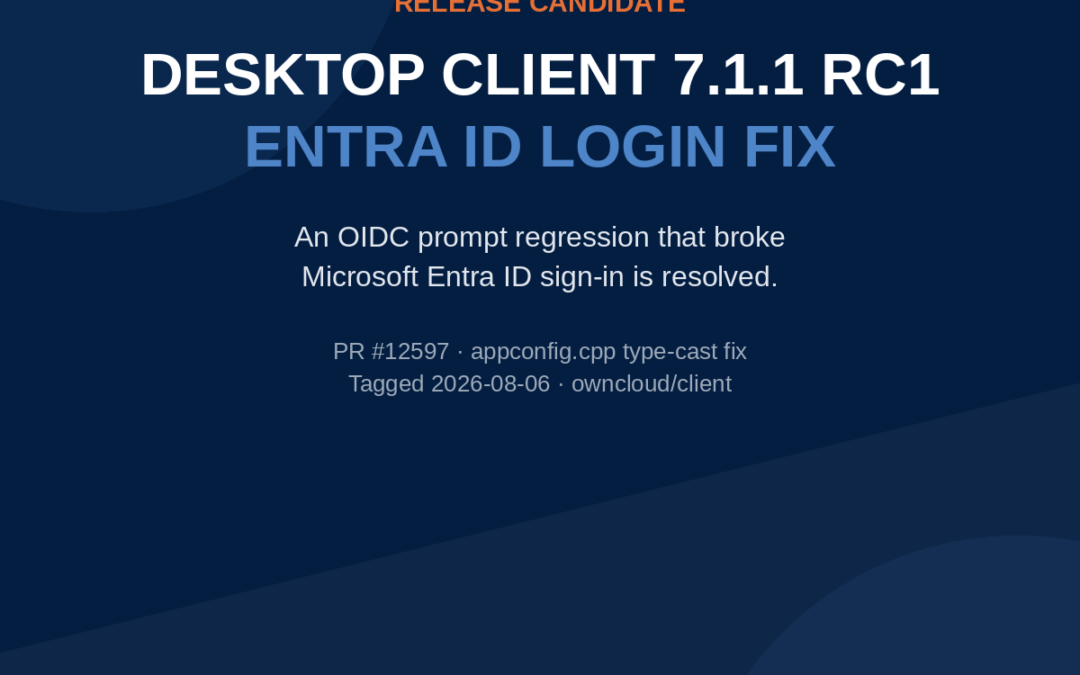
ownCloud Desktop Client 7.1.1 RC1: fixes an OIDC prompt regression breaking Microsoft Entra ID login
ownCloud Desktop Client 7.1.1 RC1 fixes an OIDC bug that broke Microsoft Entra ID login. A quint16/qint64 type mismatch, if you’re into that level of detail. RC only for now — test before you trust it.
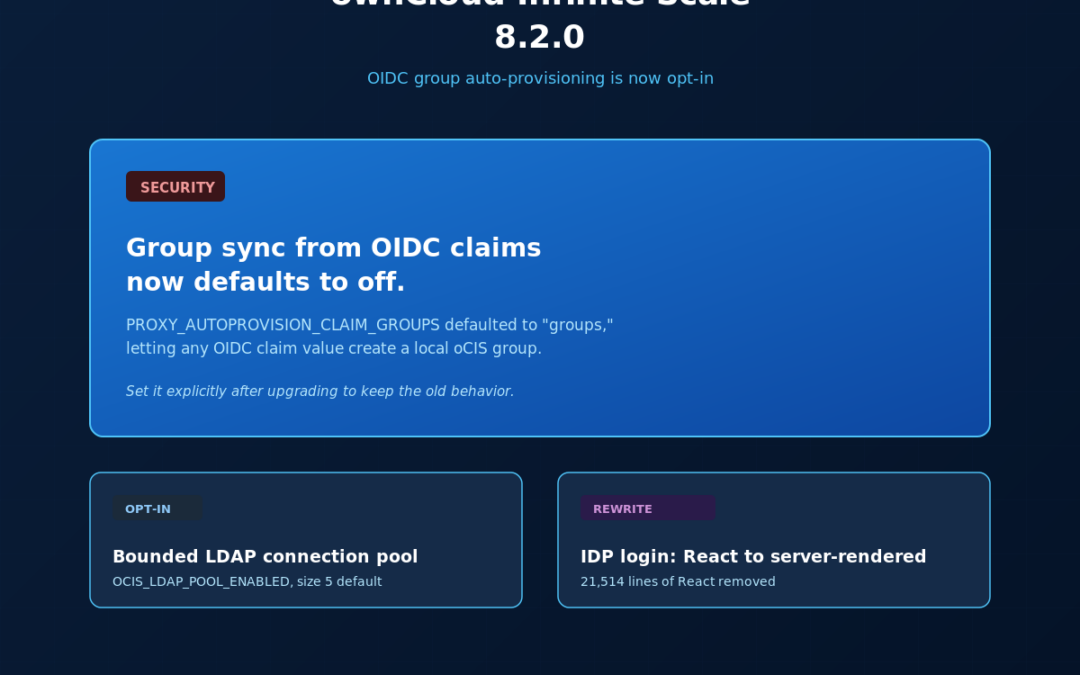
ownCloud Infinite Scale 8.2.0: OIDC Group Auto-Provisioning Is Now Opt-In
oCIS 8.2.0 is out: the identity provider’s login page dropped ~21,500 lines of React for server-rendered HTML, LDAP gets an opt-in connection pool, and ~30 bugs are fixed, several of them accessibility improvements.
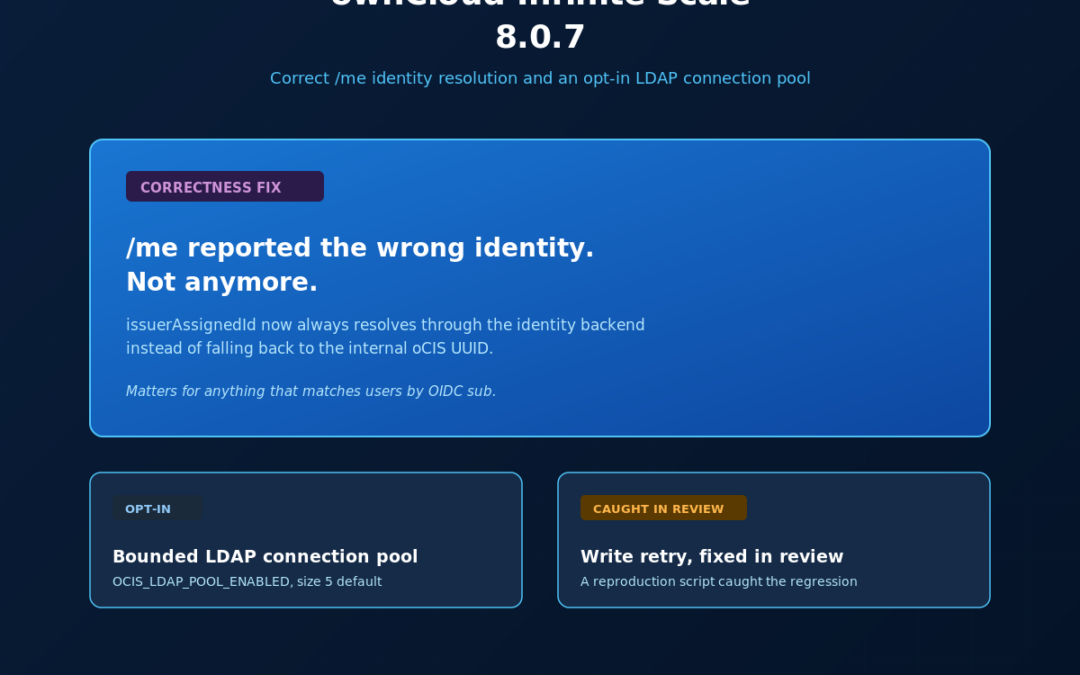
ownCloud Infinite Scale 8.0.7: Correct /me identity resolution and an opt-in LDAP connection pool
oCIS 8.0.7 fixes a real bug: /graph/v1.0/me was reporting your internal oCIS UUID instead of the OIDC sub in issuerAssignedId. If anything in your stack correlates users by external identity rather than oCIS’s UUID, this one’s for you.
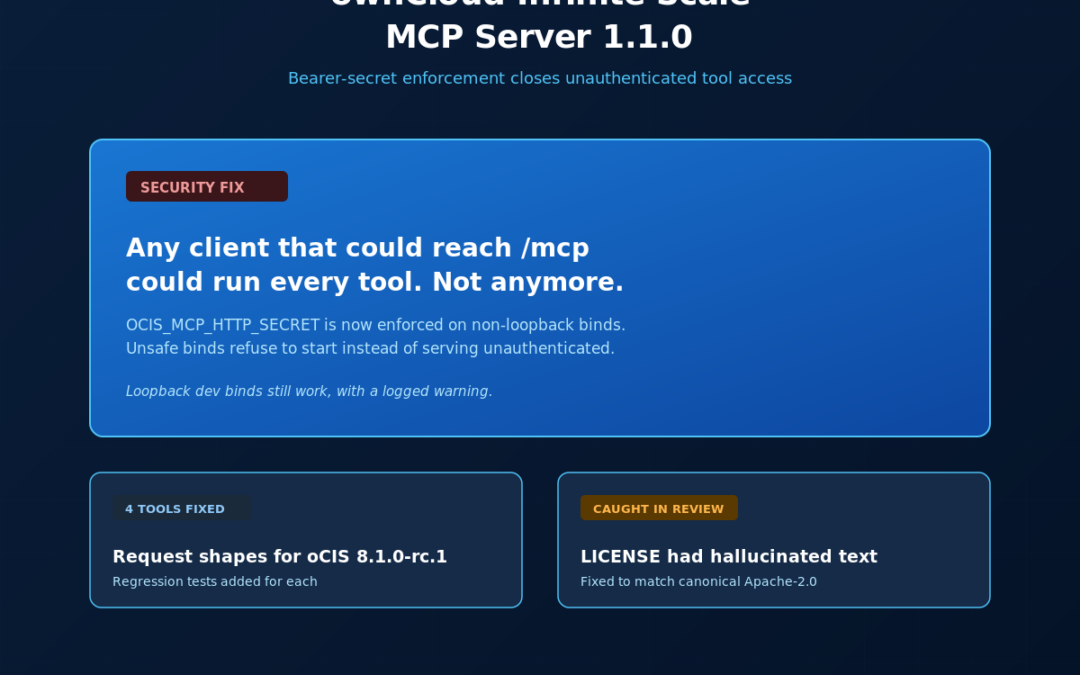
ownCloud Infinite Scale MCP Server 1.1.0: Bearer-secret enforcement closes unauthenticated tool access on the HTTP transport
Release date: July 14, 2026 Repository: owncloud/ocis-mcp-server Release page: https://github.com/owncloud/ocis-mcp-server/releases/tag/v1.1.0 The ownCloud Infinite Scale MCP Server exposes oCIS to AI assistants and agent frameworks as a set of MCP tools, letting an...
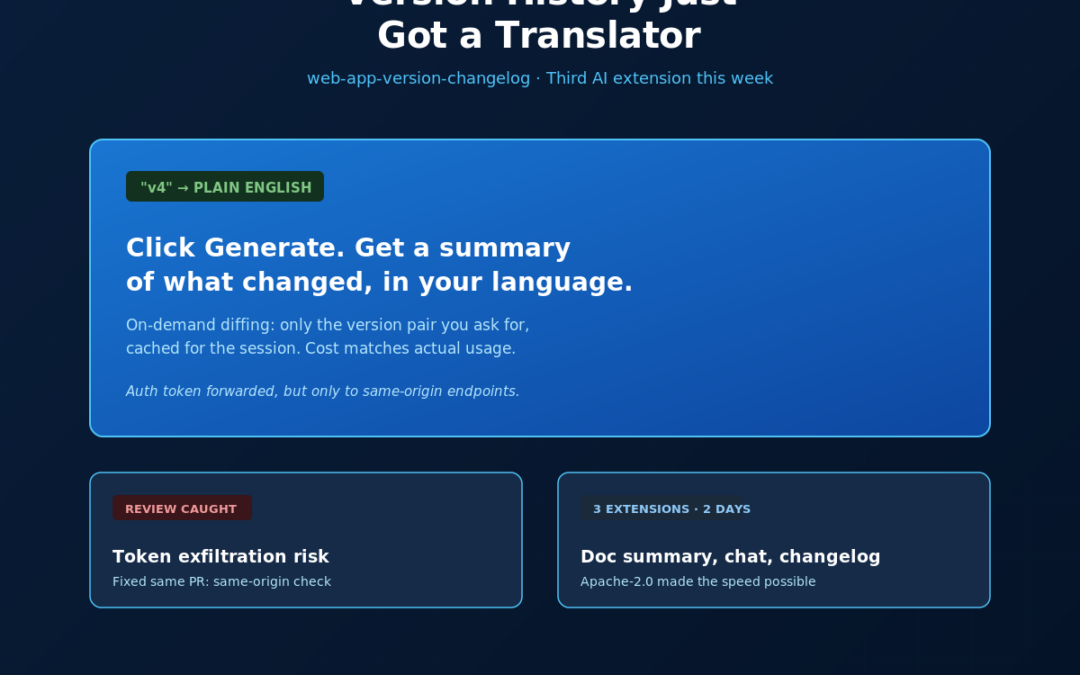
Version History Just Got a Translator
Click Generate on any file version in oCIS, get a plain-English summary of what changed, in your language. On-demand diffing means cost matches actual usage, not pre-computed for every version of every file.
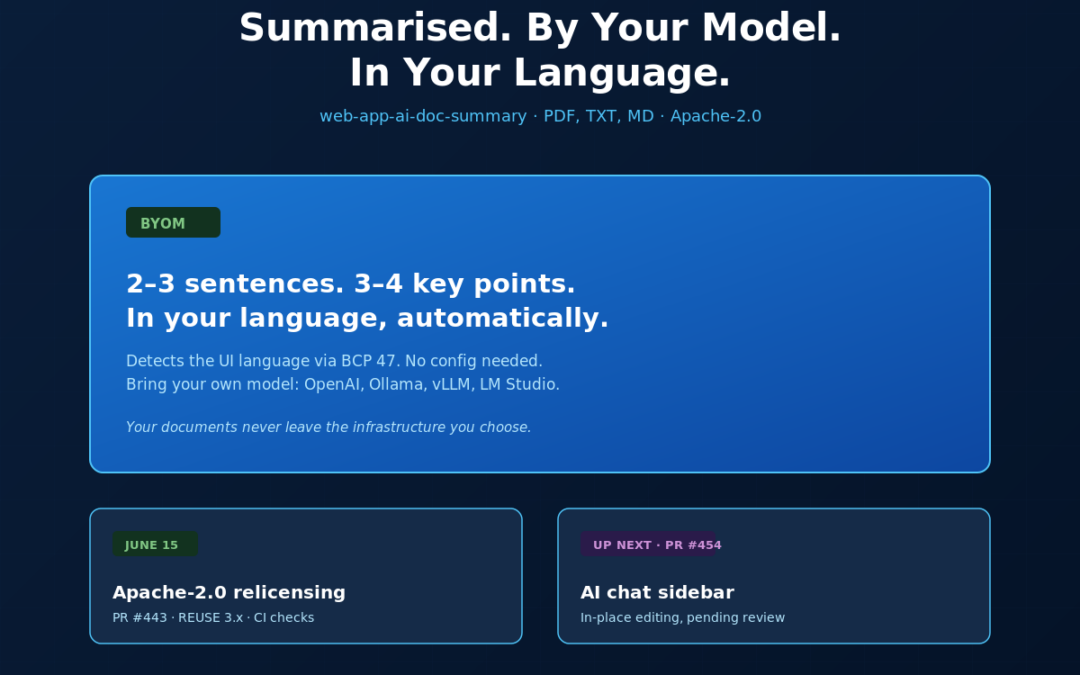
Your Documents. Summarised. By Your Model. In Your Language.
web-app-ai-doc-summary is the first AI extension to ship into the ownCloud web-extensions repository since we relicensed it to Apache-2.0 on June 15th. Lukas Hirt wrote it in a week. What It Does Open a PDF, TXT, or Markdown file in oCIS. A Summary tab appears in the...
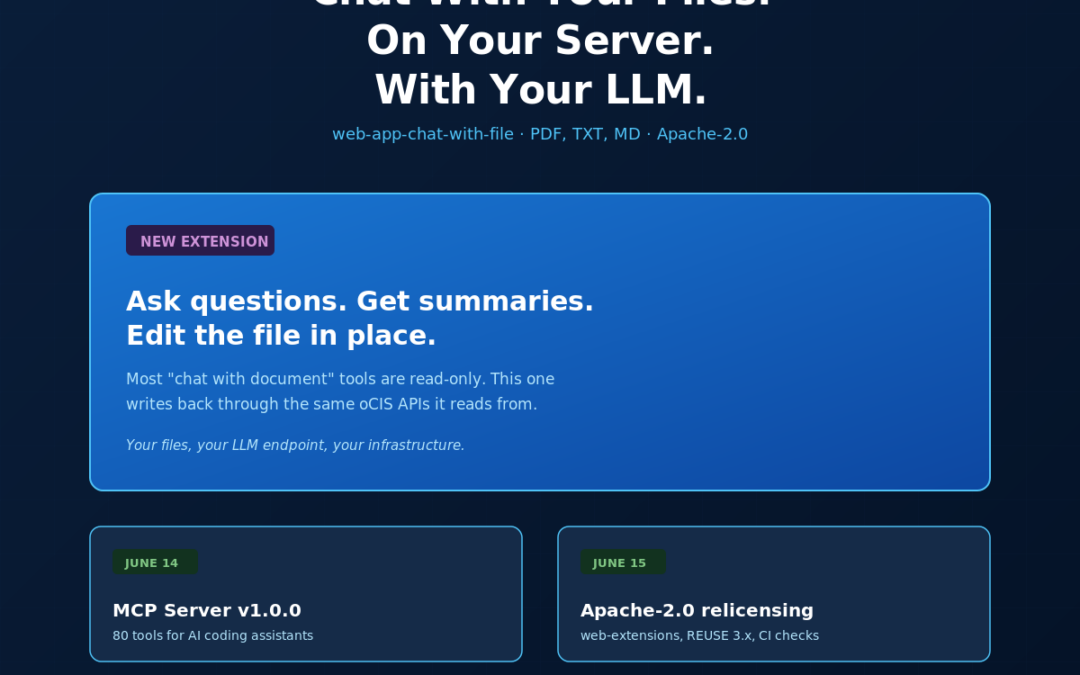
Chat With Your Files. On Your Server. With Your LLM.
Chat with your files. Edit them in place. Never leave your server. That’s what shipped in this oCIS extension, on a web-extensions repo that went Apache-2.0 the same week.
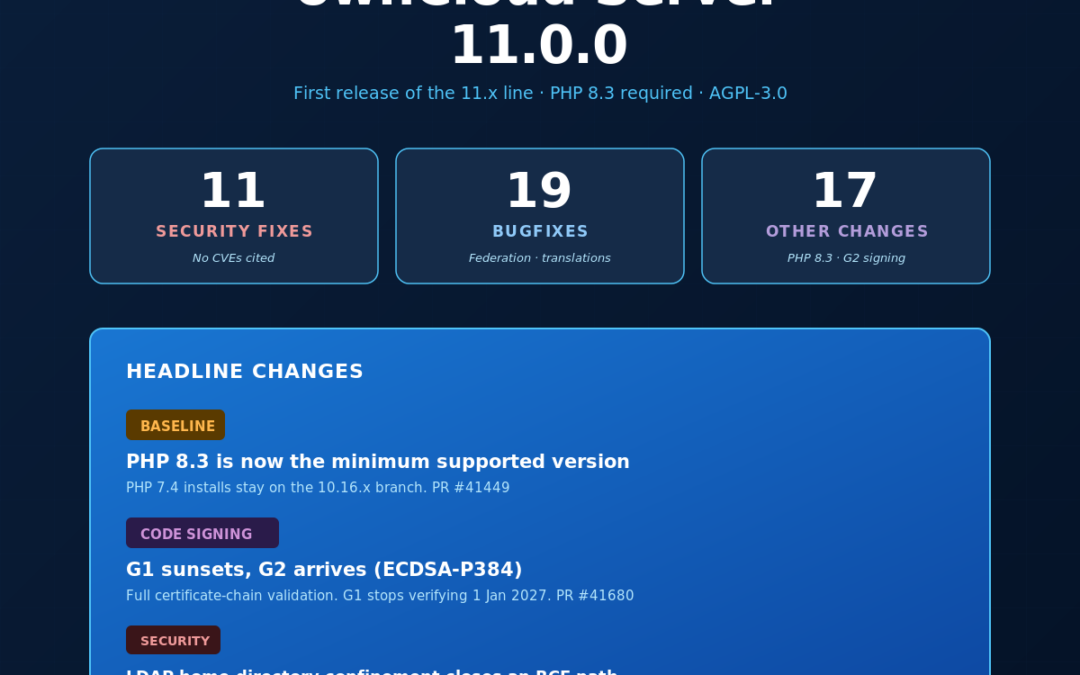
ownCloud Server 11.0.0: PHP 8.3 baseline, G2 code signing, and 11 security fixes
After three release candidates and a month of testing, ownCloud Server 11.0.0 is stable. It’s the first release built for PHP 8.3, moves app signing to a stronger G2 scheme, and folds in 11 security fixes and 19 bugfixes along the way. Thanks to everyone who tested the candidates and filed issues.
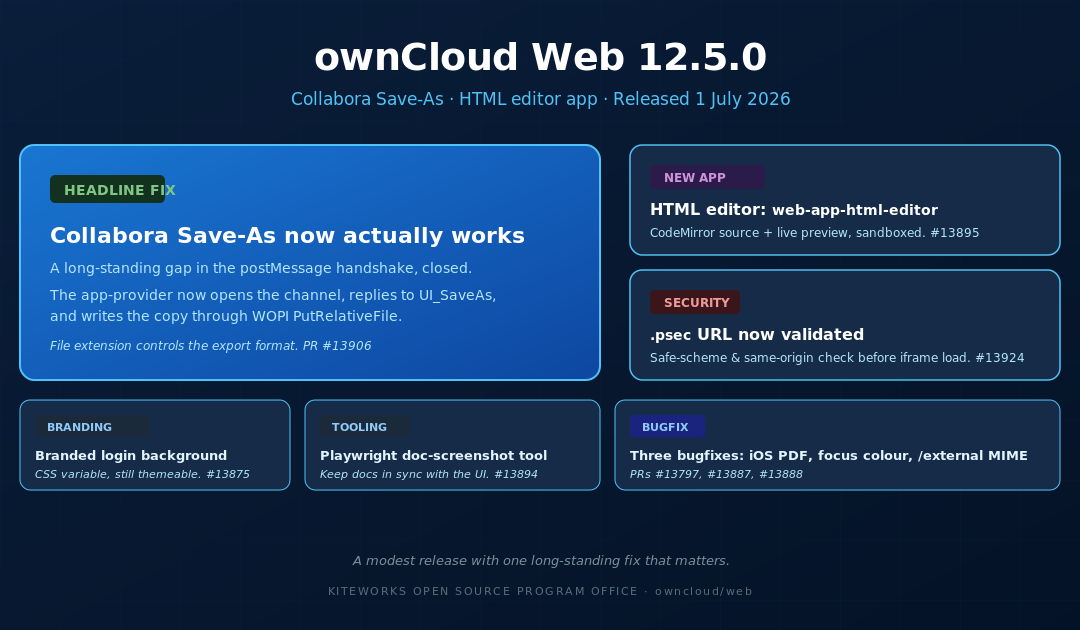
ownCloud Web 12.5.0: Collabora Save-As Support and a New HTML Editor App
ownCloud Web 12.5.0 is out. Save-As inside Collabora Online now actually works (PR #13906 closes a long-standing gap in the postMessage handshake). Plus a new lightweight HTML editor app for .html, .htm, and .xhtml files, an ownCloud-branded default login background, and a Playwright-driven screenshot tool for docs. Four bugfixes underneath, including a security-relevant .psec URL validation fix.