The old ownCloud Contributor License Agreement was aggressive.
Read the text:
“You hereby transfer to ownCloud your entire right, title, and interest (including all your rights under copyright) in the changes and enhancements to the Contribution.”
Full copyright assignment. You write the code, ownCloud GmbH owns it.
The CLA existed for a business reason: dual-licensing. AGPL for community, proprietary for enterprise. That model had its time, but is no longer necessary for where the project is going. The power asymmetry the CLA created made contributors uncomfortable, and they were right to be.
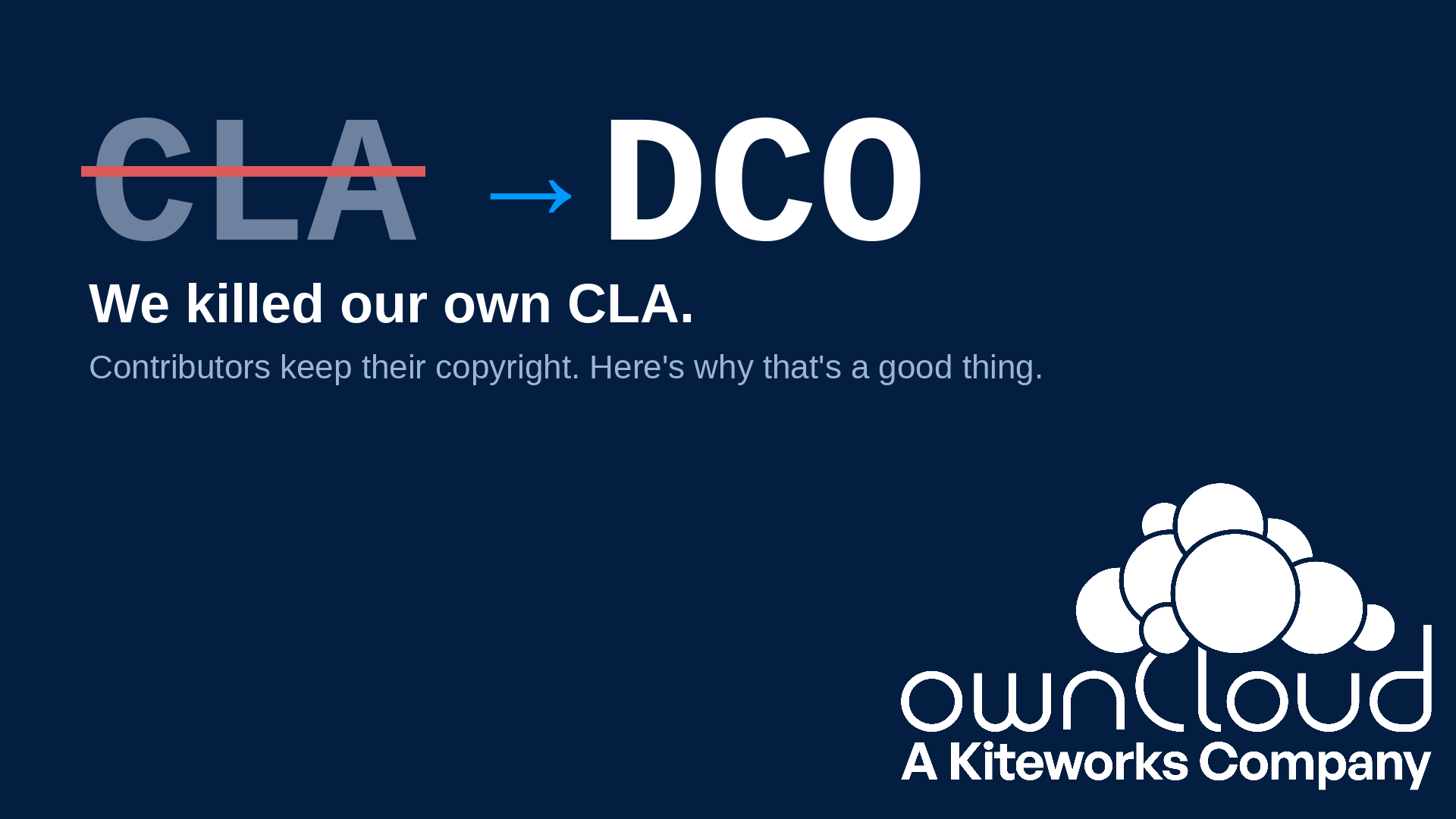
As of May 5th, 2026, the CLA will be retired. We’re replacing it with the Developer Certificate of Origin (DCO):
- Per-commit attestation of origin.
- You add a Signed-off-by line.
- You keep your copyright.
The DCO was invented by the Linux kernel project in 2004. It’s the standard for Apache 2.0 projects, which ownCloud Infinite Scale (oCIS), our Go-based successor to the PHP server (ownCloud Classic), is.
To read more about it: https://github.com/apps/dco
Previously signed CLAs?
Still valid. No action needed. New contributions just need DCO sign-off.
Corporate contributor?
The DCO’s per-commit nature makes legal approval easier than a blanket CLA.
Were you holding back because the CLA felt extractive?
That barrier is gone.
One important and interesting nuance: the old CLA is what makes our planned legally possible. Because ownCloud GmbH owns the copyright on CLA-covered contributions, we can change licenses where we hold 100% copyright.
It is interesting that the thing that we are retiring is the what gave us the ability to do so in the first place.
With the DCO, future contributors retain their . We’re making a one-way door decision.
Deliberately.
DCO enforcement rolls out repo by repo, starting with oCIS. The new Open Source Program Office (OSPO) decides the timing.
The power asymmetry is gone, and if you’ve been searching for a project to use and contribute to, this is the invitation/time and this is the project.
Tomorrow: PHP 8.3 for Classic
This is part 3 of this blog post series.
See the earlier posts: