Two codebases just became one. This is what the OSPO relicensing programme looks like when it reaches the core product.
PR #12491 merged today into owncloud/ocis (https://github.com/owncloud/ocis). 16 commits. Lukas Hirt. Jira ticket OCISDEV-5. On the surface it looks like another relicensing PR. It is not. It is a structural change to oCIS itself — the kind that redraws repository boundaries and consolidates contribution histories.
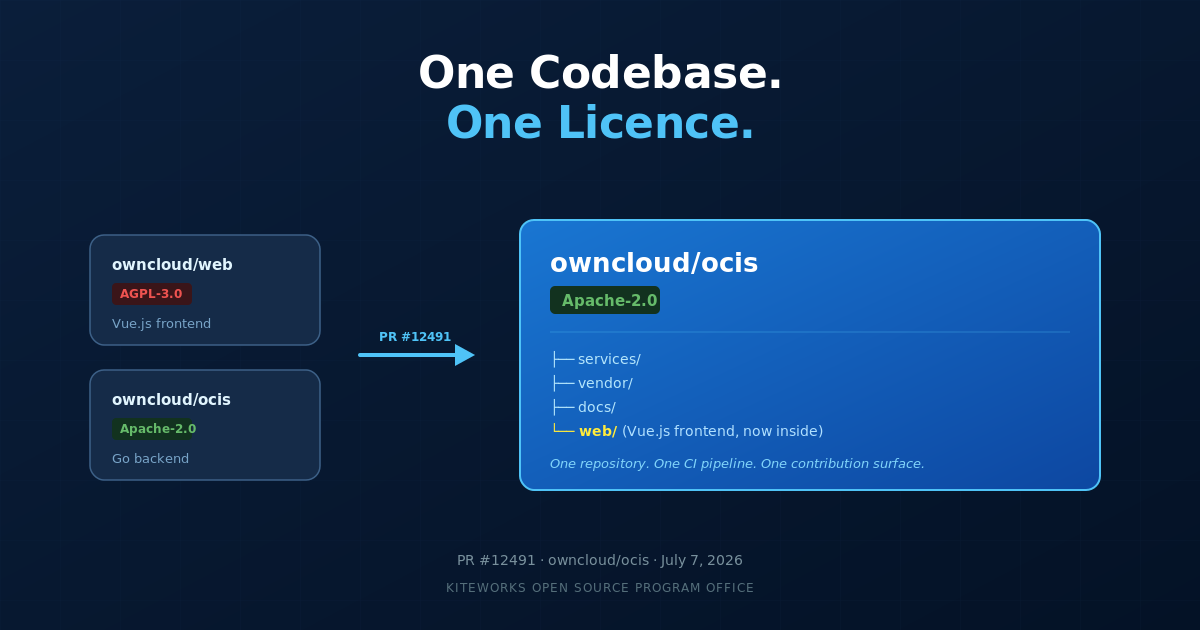
What it does: the ownCloud Web frontend — previously maintained as a separate repository at owncloud/web (https://github.com/owncloud/web), licensed under AGPL-3.0 — is now part of the owncloud/ocis repository, under the web/ directory, licensed under Apache-2.0.
One product. One contribution surface. One licence.
What Just Changed
For the past several years, oCIS has been two repositories in practice. owncloud/ocis contained the Go backend: the microservices, the storage layer, the APIs, the identity management, the search integration. owncloud/web contained the Vue.js frontend: the user interface, the file manager, the sharing dialogs, the Spaces UI, the app registry.
They were built together, deployed together, documented together. But they lived in separate repositories, carried separate licences, had separate contributor histories, separate CI pipelines, and required separate pull requests for any change that touched both.
That division no longer exists. The web frontend lives in owncloud/ocis under web/. A contributor who wants to fix a bug that spans the Go API and the Vue.js UI submits one PR to one repository. A first-time contributor cloning oCIS gets the full product in one checkout. A security researcher auditing the codebase reads one repository. The CI pipeline builds and tests the complete product in one run.
The Licence Story
owncloud/web was AGPL-3.0. We said so explicitly in the relicensing programme — the web frontend was classified in the tier that needed careful evaluation before relicensing. 200+ contributors. High visibility. A long git history predating the current OSPO framework.
That evaluation is complete. The copyright audit confirmed we hold the necessary rights. The relicensing cleared. The frontend is now Apache-2.0.
Apache-2.0 is the licence that makes oCIS deployable without copyleft considerations. Every system integrator, every partner, every organisation building on oCIS can now work with the complete product — backend and frontend — under the same permissive terms. The oCIS UI no longer carries those AGPL obligations. The oCIS codebase is uniformly Apache-2.0. This is what “going all in” looks like at the product level.
This work rests on years of contribution history. The owncloud/web repository has 200+ contributors across its lifetime. The relicensing was possible because of the copyright audit, the review by maintainers on both sides, and the engineering coordination that made the CI, build, and repository-structure changes safe to land. PR #12491 is the visible piece of a much larger effort.
What This Means for Contributors
There is one repository. One PR template. One DCO sign-off. One CI pipeline to watch. One set of maintainers to work with.
A developer building a new oCIS feature no longer needs PRs in two repositories in a specific order. Frontend changes to an API endpoint no longer require coordinating across two repos. The AI-assisted contribution workflow at owncloud.dev just got simpler: one repo to clone, one codebase to explore, one place to submit.
What Happens to owncloud/web
The owncloud/web repository will be archived. The git history, the issues, the pull requests — all of it remains accessible as a permanent record. Links into owncloud/web will continue to resolve. The code moved, it did not disappear.
If you have an existing fork of owncloud/web, migrate your work to the web/ directory in owncloud/ocis. The structure is preserved. The path changes.
The Sprint That Changed oCIS’s Architecture
| Date | What |
| June 15 | web-extensions relicensed to Apache-2.0 |
| June 17 | AI document summary extension |
| June 17 | AI chat-with-file extension |
| June 18 | AI version changelog extension |
| June 22 | AI image alt-text generator |
| July 7 | ownCloud Web merged into oCIS, relicensed to Apache-2.0 |
The extension PRs were the visible, user-facing work. This PR is the structural work underneath. It’s what makes the extension PRs, and everything that follows, land in a coherent product. The OSPO relicensing programme is working systematically from the edges inward toward a uniform licence across the entire oCIS product.
Where oCIS Stands Now
owncloud/ocis is now a monorepo in the truest sense. The Go backend and the Vue.js frontend share a repository, a licence, a contribution workflow, and a CI pipeline. Both are Apache-2.0. Both use DCO. Both build and test together.
Fork it, build on it, extend it, submit PRs. The entire product is in one place.
github.com/owncloud/ocis/pull/12491 · github.com/owncloud/ocis
Lukas Hirt is a Collaborator on ownCloud. PR #12491 merged July 7, 2026.
ownCloud OSPO: moc.skrowetik@opso · kiteworks.com/opensource